December 7, 2001 NYT Opinions
The Peacemaker
of the Pashtun Past
By KARL E. MEYER
As the Afghan war enters into what may be its final days, and the international
community begins discussing its next steps, Americans will be learning more
about the warrior people known to the British as Pathans, and more correctly
nowadays as Pashtuns. Most of the Taliban were Pashtun — as is the new
interim leader of Afghanistan, Hamid Karzai, to whom Mullah Muhammad Omar,
the Taliban leader, has ceded power. The Pashtuns number upwards of 20 million,
and their squat stony villages straddle the Durand Line that nominally demarcates
Pakistan from Afghanistan, where Pashtuns form the largest ethnic group. These
are the fighters who inspired reams of fearful and admiring verse from Rudyard
Kipling, the sharpshooters blessed with perfect sight who picked off the soldiers
of the British Raj. But the Pashtuns also produced one of the most remarkable
pacifist movements of the 20th century.
British officers were so impressed by Pashtun valor that in 1847 they created a Pashtun force, the Corps of Guides — its emblem was crossed sabers over the slogan "Rough and Ready" — that was soon celebrated in the Indian Army. They led the way in adopting uniforms in a new color, khaki, and became the prototype for today's special forces.
The fascination with Pashtuns endured until the Raj's demise. Sir Olaf Caroe, the last British governor of the North-West Frontier, left a systematic account, "The Pathans" (1958), complete with pullout maps and translations of love poems by the great Pashtun bard, Khushal Khan, who died in the 17th century. Caroe favored the partition of India and believed that a Muslim state and its frontier warriors would form a firewall blocking a Soviet advance toward the Persian Gulf. The success of this policy depended on Pashtun military prowess — and Caroe's greatest problem was a Pashtun pacifist, Abdul Ghaffar Khan, who confounded every cliché about Caroe's favored martial race.
Ghaffar was renowned as "the frontier Gandhi." His followers, the Servants of God, were nicknamed Red Shirts because of their brick-colored garb. All had to swear: "I shall never use violence. I shall not retaliate or take revenge, and shall forgive anyone who indulges in oppression and excesses against me."
For two decades, Ghaffar and his Red Shirts dominated the North-West Frontier without resort to violence, enduring prison and torture. Ghaffar's friend and mentor, Mohandas Gandhi, called his feat "a miracle." Nevertheless, the most remarkable Pashtun of his era is forgotten, not only because his cause was lost — he sought self- rule for his people within a united, secular India — but because it was an embarrassment to Britain, India and Pakistan alike.
A new biography, "The Pathan Unarmed" by Mukulika Banerjee, adds fresh light. The author began her study as a graduate student in the 1990's, and after learning Pashto managed to interview 70 surviving Red Shirts. She found that Ghaffar's pacifism grew out of his concept of jihad, or holy war, because nonviolent resistance "offered the chance of martyrdom in its purest form, since putting one's life conspicuously in one's enemy's hands was itself the key act."
Using this strategy, the Red Shirts in 1930 shut down Peshawar for five days protesting colonial rule, becoming valued Muslim allies of Gandhi's predominantly Hindu Congress Party. The movement flourished, and each wave of arrests confirmed Ghaffar Khan's status as the liberating champion of his people, who now called him Badshah Khan, or the Khan of Khans.
In 1947, in final negotiations for independence, Gandhi acceded to partition and the establishment of Pakistan. A distraught Ghaffar Khan, feeling abandoned by his Hindu allies and angrily aware that Caroe favored a Muslim state, asked his followers to boycott the referendum on joining Pakistan, whose founding he opposed because he wanted a united, secular India. Now derided as a lackey of "the Hindu Raj," Ghaffar Khan was imprisoned and charged with sedition by Islamabad's new masters. When the great rebel insisted that he wanted only autonomy within Pakistan, it was rejected as a ruse, since Afghanistan seized on this moment to revive territorial claims to Peshawar and other areas once held by Kabul.
The sequel was a martial crackdown by Pakistani authorities, echoing the British
line about the incorrigible violence and suspect loyalties of Pashtuns. Ghaffar
was eventually released from jail but banished from the frontier. In his last
years he was allowed to revisit Peshawar, where in 1988 he died at the age
of 98. According to an earlier biography by M. S. Korejo, a Pakistani diplomat,
a funeral procession stretching for miles carried Badshah Kahn's body across
the border to Jalalabad, the summer home of Afghan kings. It was, the author
writes, "a caravan of peace, carrying a message of love" from Pashtuns
east of the Khyber to those on the west.
This forgotten chapter suggests that Islam is more mutable than either its radical adherents or its Western detractors allow — and that Pashtun history offers an extraordinary precedent for peace as well as a legacy of war.
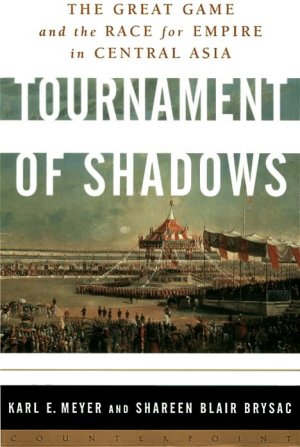
Karl E. Meyer is editor of the World Policy Journal and co-author, with Shareen
Brysac, of "Tournament of Shadows: The Great Game and the Race for Empire
in Central Asia."
I found this a very educational book and one worth reading if one is interested in what motivates the Afghans and why the West is having so much trouble with this part of the world. Since the US invation following the drama over the presence of Osama bin Laden, chief architect of the anti west terrorism of 911 (NY World Trade Centre September 11 2001) and Kuda Beach and elsewhere.
I bought the book because of my interest in Foreign Affairs, particularly the US's involvement outside the US, and Australia's own interests. My Grandfather fought in the North West Territories as a medic in the British Army, so my family has some interest in the area, if only little old me.
A lot of hard work has gone into putting together this work, both research and interviews, not to mention the travel, the result is a journey through the history of the area with particular attention to British, Russian and American interests, mainly at a time before our Cold War started.
You can visit their website at Tournament of Shadows and read some more Reviews.